🌍 India and Haryana
India: A Diverse Nation
India is one of the world’s oldest civilizations and today stands as the largest democracy. It covers a vast land area of about 3.28 million square kilometers, making it the seventh-largest country. Bordered by the Himalayas in the north and the Indian Ocean in the south, India’s geography ranges from deserts and plains to plateaus and coasts.
The population of India is over 1.4 billion, representing a mosaic of religions, cultures, and languages. Hindi and English are widely used for communication, while each state has its own regional language. India is also known for religious diversity, with Hinduism, Islam, Christianity, Sikhism, Buddhism, and Jainism practiced across the country.
Politically, India is a federal republic with a President as the head of state and a Prime Minister leading the government. Its Constitution, adopted in 1950, guarantees fundamental rights to citizens and establishes a parliamentary system.
Economically, India has transformed into one of the fastest-growing economies in the world. Information technology, agriculture, textiles, manufacturing, and renewable energy play key roles. It is also among the top destinations for foreign investment. At the same time, India balances challenges such as poverty reduction, infrastructure development, and environmental conservation.
Culturally, India has gifted the world yoga, Ayurveda, classical music, and dance forms such as Bharatanatyam and Kathak. Festivals like Diwali, Holi, Eid, Christmas, and Baisakhi reflect unity in diversity. From the Taj Mahal to modern skyscrapers, India showcases a blend of tradition and progress.
Haryana: The Land of History and Prosperity
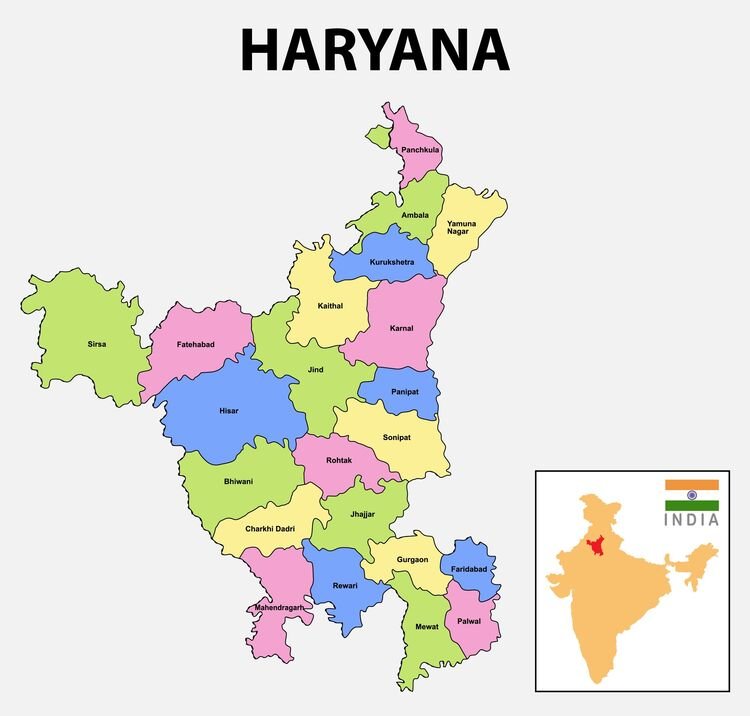
Haryana, located in northern India, is one of the country’s most economically advanced states. It was carved out of Punjab on 1 November 1966 to create a separate Hindi-speaking state. Chandigarh serves as the joint capital of both Haryana and Punjab.
Geographically, Haryana shares borders with Delhi, Rajasthan, Uttar Pradesh, Himachal Pradesh, and Punjab. Its central location has made it a hub for connectivity. The Aravalli Hills lie in its southern part, while fertile alluvial plains dominate much of the state.
Historically, Haryana holds immense significance. The legendary battle of Mahabharata was fought on the land of Kurukshetra. Throughout history, it has witnessed invasions, empires, and freedom struggles, shaping its cultural richness.
Economically, Haryana ranks among the richest states in India in terms of per capita income. It is an industrial powerhouse with cities like Gurugram and Faridabad emerging as IT, automobile, and corporate hubs. The agricultural sector is equally strong, with Haryana being a leading producer of wheat, rice, and milk. Its farmers played a key role in India’s Green Revolution.
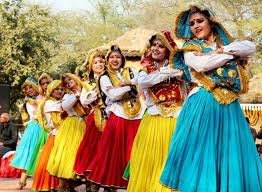
Culturally, Haryana is known for its folk music, dances like Phag and Raas, and colorful festivals such as Teej and Holi. Traditional sports like kabaddi and wrestling remain popular, and the state has produced world-class athletes who excel in wrestling, boxing, and hockey.
Socially, Haryana has a mix of urban progress and rural traditions. Its people are known for their straightforwardness, bravery, and hospitality. Villages still preserve the old customs of community living, while cities display rapid modernization.
Haryana and Gurgaon
Haryana
Haryana is a northern state of India, created on 1 November 1966 after separating from Punjab. It is located around the national capital, Delhi, and shares borders with Punjab, Himachal Pradesh, Rajasthan, and Uttar Pradesh. The state is famous for its historical importance, as the great battle of the Mahabharata was fought in Kurukshetra.
Haryana is both agriculturally strong and industrially advanced. It played a major role in the Green Revolution, becoming a leading producer of wheat, rice, and milk. At the same time, Haryana has developed into one of India’s richest states in terms of per capita income.
The culture of Haryana reflects simplicity, bravery, and tradition. Folk music, dances, fairs, and festivals like Teej and Holi are integral to its identity. Haryana has also produced many renowned athletes in wrestling, boxing, and kabaddi, making it a powerhouse in Indian sports.
Gurgaon (Gurugram)
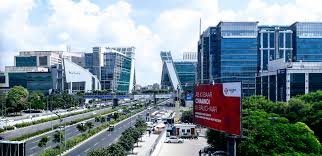
Gurgaon, officially known as Gurugram, is one of the most developed and modern cities of Haryana. Located just southwest of Delhi, it is often called the “Millennium City of India.” Over the last three decades, Gurgaon has transformed from a small town into a global corporate hub.
It is home to the offices of many multinational companies, especially in IT, automobile, finance, and real estate. The city has modern skyscrapers, shopping malls, luxury housing societies, and entertainment centers, making it one of India’s fastest-growing urban areas.
Despite being highly modern, Gurgaon is still part of Haryana’s traditional landscape. Many nearby villages preserve local culture and farming practices. This blend of modern corporate lifestyle and rural tradition gives Gurgaon a unique character.
Mahabharata in Haryana
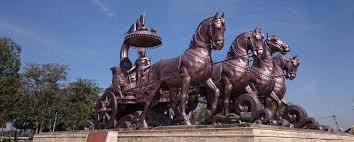
Haryana is often called the land of the Mahabharata because the famous battle of Kurukshetra was fought here more than 5,000 years ago. Kurukshetra, a district in Haryana, is considered a sacred place where Lord Krishna delivered the Bhagavad Gita to Arjuna on the battlefield. This teaching became one of the greatest spiritual and philosophical guides for humanity.
According to legends, many places in Haryana are linked with episodes from the Mahabharata:
Kurukshetra – The main battlefield where the 18-day war between the Pandavas and Kauravas was fought.
Jyotisar (Kurukshetra) – The spot where Lord Krishna gave the divine sermon of the Bhagavad Gita. A holy banyan tree still stands there, symbolizing that moment.
Brahma Sarovar (Kurukshetra) – A sacred tank where, according to belief, Lord Brahma created the universe. Pilgrims take a holy dip here, especially during solar eclipses.
Panipat – Though more famous for later medieval battles, it is mentioned as part of the Kuru region during Mahabharata times.
Kaithal and Pehowa – These towns are also linked with ancient Mahabharata references.
The Mahabharata not only makes Haryana a land of history but also a land of spirituality and pilgrimage. Even today, lakhs of devotees and tourists visit Kurukshetra and nearby places to connect with the epic’s legacy.